 Nobody warns you about the ink bill until it’s already eating your margins.
Walk into any print shop and you’ll see the same pattern. The owner agonized for months over which DTG printer to buy. They compared printhead specs, watched a dozen YouTube reviews, negotiated hard on the machine. Then, when it came time to load the ink, they grabbed whatever the reseller tossed into the quote. That’s backwards. The printer is a one-time decision. The ink is a decision you live with every single day, on every single shirt, for as long as you own the machine.
Here’s how to get it right.
Start with the garment, not the ink
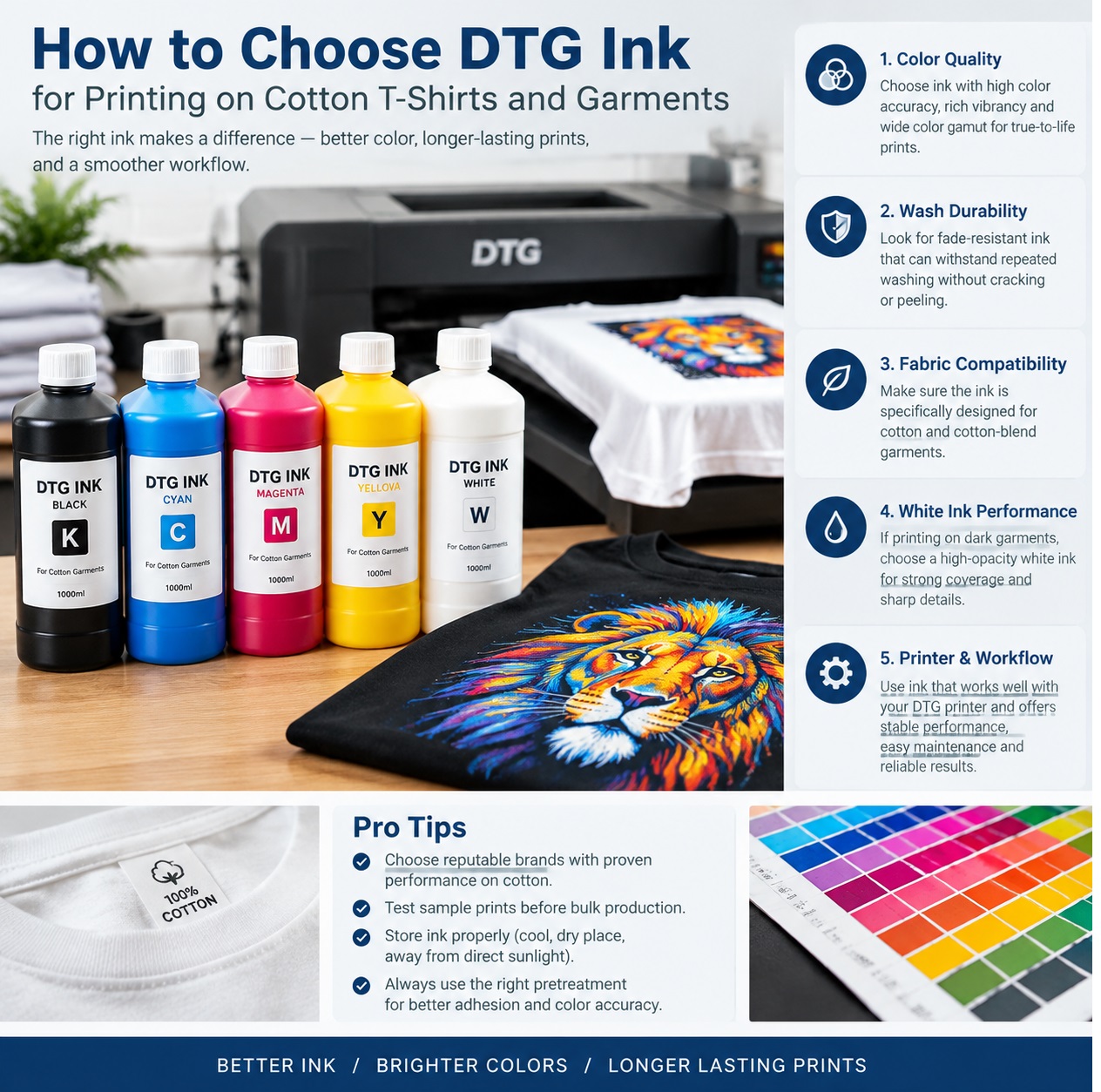
DTG ink behaves differently depending on what it’s sitting on. A 100% ring-spun cotton tee drinks ink differently than a heavy 6.5 oz cotton crew, and both behave nothing like a 50/50 poly-cotton blend. If your shop runs mostly combed cotton and tri-blends, you need ink formulated for those surfaces. If you’re printing on dark garments all day, your white ink is doing 80% of the heavy lifting and its opacity and jetting stability matter far more than your CMYK set.
Get honest about your product mix before you order a single liter. The wrong ink on the wrong fabric shows up as dull blacks, cracked prints after three washes, and customers who never order again.
White ink is where the money and the misery live
Every DTG operator learns this the hard way. White pigment is dense, heavy, and prone to settling. Cheap white ink clogs nozzles, prints chalky, and separates in the cartridge if you let it sit over a slow weekend. Good white ink flows clean, builds opacity in fewer passes, and holds up under repeated washing without turning gray.
When you’re comparing brands, ask for the titanium dioxide loading and the particle size. Smaller particles mean smoother flow and less sedimentation. If a supplier can’t answer that question, that tells you plenty.
Match the ink to your printhead, always
Your printer’s printhead is not a suggestion. It’s a constraint. Inks are engineered with specific viscosity, surface tension, and curing characteristics for specific head technologies. Pouring an off-brand ink into a machine calibrated for something else is how you void a warranty and destroy a two-thousand-dollar printhead in a week.
Before you buy anything, confirm three things in writing: the ink is certified for your exact printer model, the manufacturer will stand behind the warranty if you use it, and the batch has a documented shelf life. Vague answers are a red flag.
The OEM versus third-party question
OEM ink costs more. Third-party ink costs less. That’s the entire conversation most people have, and it’s incomplete.
The real math includes clogged nozzle downtime, wasted pretreat, ruined garments, and the labor hours spent reprinting jobs. A third-party ink that saves you forty dollars a liter but costs you six hours of maintenance a month is not cheaper. It’s just a bill with a delayed due date.
That said, there are excellent third-party inks on the market. The ones worth buying come with independent test data, a clear return policy, and a support line staffed by people who actually print. If a vendor disappears after the sale, so will your profits.
Wash durability isn’t a marketing line, it’s a specification
Ask any supplier what wash cycle their ink survives. The good ones will tell you a number. The great ones will send you a sample and let you test it yourself.
Run your own test before you commit to a bulk order. Print a test shirt, cure it exactly per the ink spec, then wash it five times in warm water with a normal detergent load. Check for cracking, fading, and color shift. Do this with every new batch you receive, because formulation changes happen quietly and your customers will notice before you do.
Climate, storage, and the shelf life nobody mentions
DTG ink is perishable. Heat degrades it. Cold separates it. Humidity changes how it jets. If your shop runs hot in summer, your ink is aging faster than the label suggests.
Store ink between the temperatures the manufacturer specifies, keep it out of direct sunlight, and rotate your stock so older batches get used first. Write the delivery date on every cartridge. A liter that sat on a shelf for eighteen months is not the same product as one that arrived last week, even if the label is identical.
Calculate cost per print, not cost per liter
This is the number that actually matters. Take the price of a liter, divide by the realistic number of prints you get at your average coverage, then add the cost of pretreat, labor, and rejected shirts. Compare that final figure across ink options.
You’ll often find that the premium ink wins, because it lays down opacity in fewer passes, wastes less on cleaning cycles, and produces fewer rejects. Cheap ink is expensive when you measure it correctly.
Buy samples, test hard, then commit
No reputable supplier expects you to buy a fifty-liter drum on faith. Order small, print your hardest jobs on your most difficult fabric, wash the results, and inspect them under daylight. Then decide.
The shops that last are the ones that treat ink as a core input rather than an afterthought. Pick the right formulation for your fabric, your printhead, and your climate. Test it like your reputation depends on it, because it does.
Get that part right and everything downstream gets easier: fewer clogs, faster turnaround, brighter whites, and customers who come back with the same order instead of a complaint.