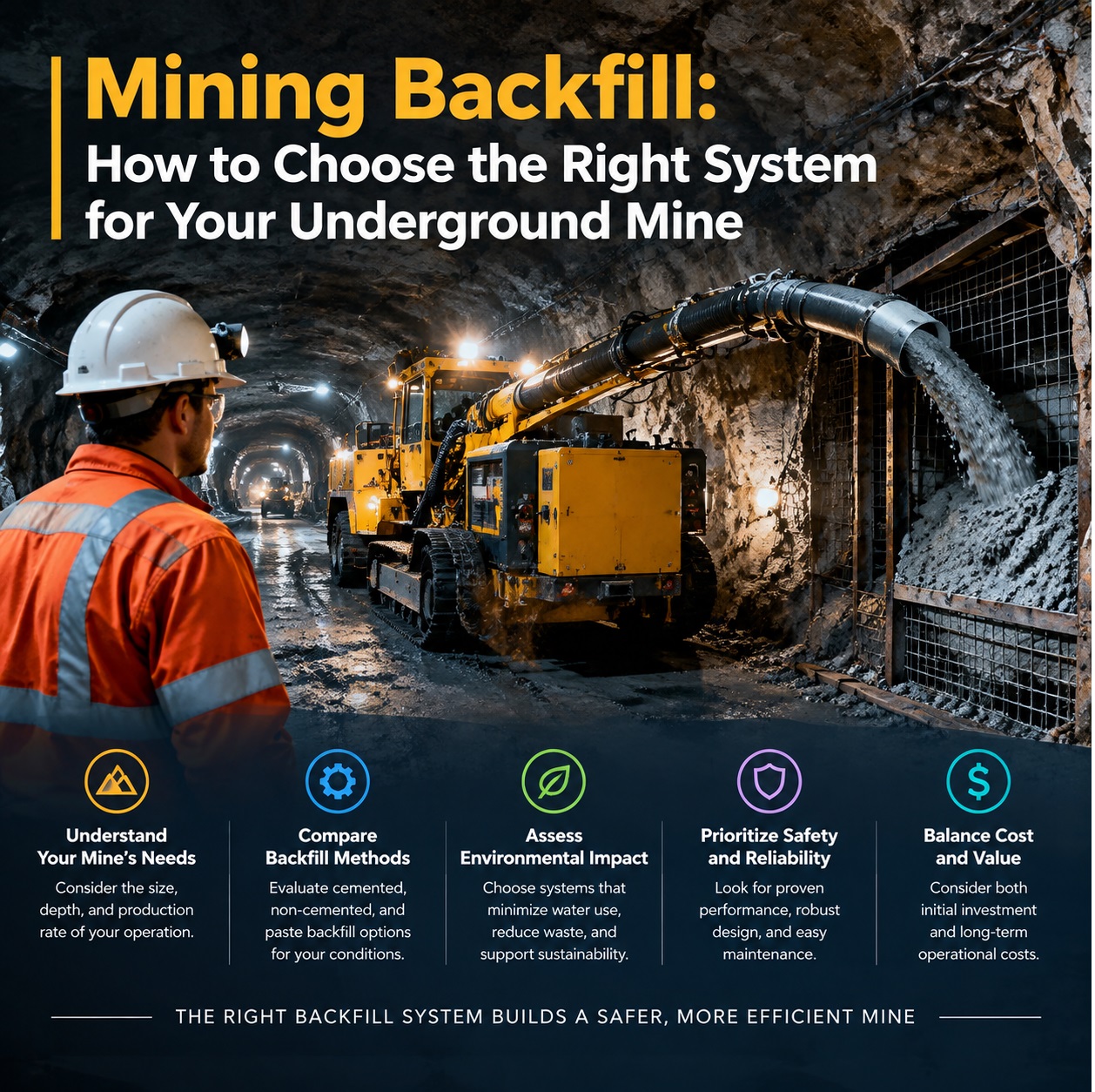
 The wrong mining backfill system doesn’t just cost money. It quietly rewrites your mine plan, your safety case, and your closure liability. Choose well, and backfill becomes a production tool. Choose badly, and every stope turns into a negotiation with water, binder, and time.
Start With the Orebody, Not the Catalog
Backfill is not a product you bolt onto a mine. It is a response to geology, mining method, and scheduling. A paste plant that performs beautifully in a deep, high-stress gold mine can choke in a shallow, high-throughput zinc operation. Before you compare systems, get the basics on the table.
What is the mining method? Cut-and-fill, longhole open stoping, sublevel caving, room-and-pillar, and drift-and-fill all demand different fill strengths, delivery rates, and exposure timing. A primary stope that will be blasted next to a filled secondary stope needs far more strength than a void that will never be exposed.
What is the stope geometry? Narrow veins, wide stopes, irregular ore contacts, and long strike lengths change how fill flows, how it drains, and how it supports the walls. Paste fill shines in complex shapes because it can be pumped and placed with less water. Hydraulic fill can move large volumes cheaply, but it brings drainage, barricade, and water-handling duties.
What does the rock mass expect? The fill must work with the stress regime, not against it. High stress, seismic activity, and weak hanging walls push you toward higher-strength cemented fill and tighter quality control. Low-stress, low-exposure stopes may be fine with rock fill or a leaner mix.
The Four Numbers That Decide More Than Any Brochure
- Required strength. Define the unconfined compressive strength and the exposure conditions. A fill that only needs to stand for a few days is a different animal from one that must hold a wall for months. Binder content is the biggest lever on cost, so over-specifying strength is a silent budget killer.
- Tailings characterization. Particle size distribution, specific gravity, chemistry, sulphide content, and water quality all matter. Your tailings are not the same as the next mine’s tailings. Lab testing with your material is non-negotiable. If a vendor quotes a mix design without seeing your tailings, you are buying a guess.
- Throughput and cycle time. How many cubic meters per hour must go underground? How long can a stope wait before the next blast? Paste fill may give faster cycle times and less drainage, but it needs a paste plant, a distribution system, and disciplined scheduling. Hydraulic fill may be simpler at the plant but slower underground because of water management.
- Water balance. Water is the hidden tax on backfill. Hydraulic fill sends water underground, which must be drained, pumped, and treated. Paste fill sends less water, but it demands careful rheology control. If your mine already struggles with water, that single factor can outweigh a lower binder cost.
Match the System to the Job
Hydraulic fill uses classified mill tailings, often with a small amount of cement for exposed faces. It is well understood, relatively low cost, and capable of high tonnages. The trade-off is water. You need barricades, drainage, and a pumping system that can handle the return water. It suits mines with good drainage and moderate strength requirements.
Paste fill uses full tailings, dewatered to a high solids concentration, mixed with binder, and pumped or gravity-fed underground. It produces a strong, dense fill with minimal bleed water. That means less water handling, lower barricade loads, and better support for high-stress stopes. The cost sits in the plant, the binder, and the control systems. For many modern underground mines, paste fill is the backbone of a low-dilution, high-recovery operation.
Cemented rock fill blends waste rock with a cementitious slurry. It delivers high strength and can fill large voids quickly. It is often used where waste rock is abundant and where very high exposure strength is needed. The catch is logistics. You need a reliable rock supply, a mixing and delivery system, and a crew that understands the difference between fill and concrete.
Rock fill is the simplest option: waste rock placed underground, usually without cement. It is cheap and useful for void filling, but it offers little structural support. Treat it as a bulk void reducer, not a primary support system.
Aggregate fill uses imported sand, gravel, or crushed rock. It can be a lifesaver when tailings are unavailable or unsuitable, but the cost of sourcing, hauling, and processing aggregate can dwarf the savings elsewhere. Use it when the mine plan truly demands it, not because it feels familiar.
Where the Money Hides
The sticker price of a backfill system is rarely the real number. Total cost of ownership includes binder, energy, water treatment, pipeline wear, pump maintenance, plant labor, surface haulage, and downtime. It also includes the cost of getting it wrong: diluted ore, delayed stopes, unstable walls, and rework.
A better backfill system can pay for itself through higher extraction, less dilution, faster cycle times, and safer working conditions. It can also reduce surface tailings storage and lower closure risk. Those benefits do not show up in a simple cost per cubic meter comparison, but they show up in the mine’s cash flow and license to operate.
The Vendor Test
Do not buy a backfill system from a catalog. Buy it from people who have solved problems like yours. Ask for lab testing on your tailings, a pilot program if the risk is high, and references from mines with similar geology and mining methods. Ask how they handle binder variability, pipeline blockages, and sudden changes in tailings feed.
Look for a partner who will challenge your assumptions. The best backfill engineers will tell you when paste fill is overkill, when hydraulic fill is a water trap, or when your strength specification is costing you money for no reason. They will also stay after commissioning to train your team, tune the mix, and help you build a data-driven operation.
A Final Check Before You Commit
Walk the proposed route underground. Check the boreholes, pipelines, barricades, and drainage. Talk to the operators who will run the plant and the miners who will work next to the fill. Model the stope sequence with the fill cycle time, not against it. Then build a total cost of ownership model that includes every major risk.
The right backfill system is not the most advanced one. It is the one that fits your orebody, your tailings, your people, and your production plan. Get that fit right, and backfill stops being a cost center. It becomes the quiet engine that keeps your underground mine safe, productive, and profitable.
If you are planning a new backfill plant or fixing one that underperforms, start with your tailings, your stope shapes, and a clear definition of required strength. The rest is engineering, logistics, and a partner who knows the difference.